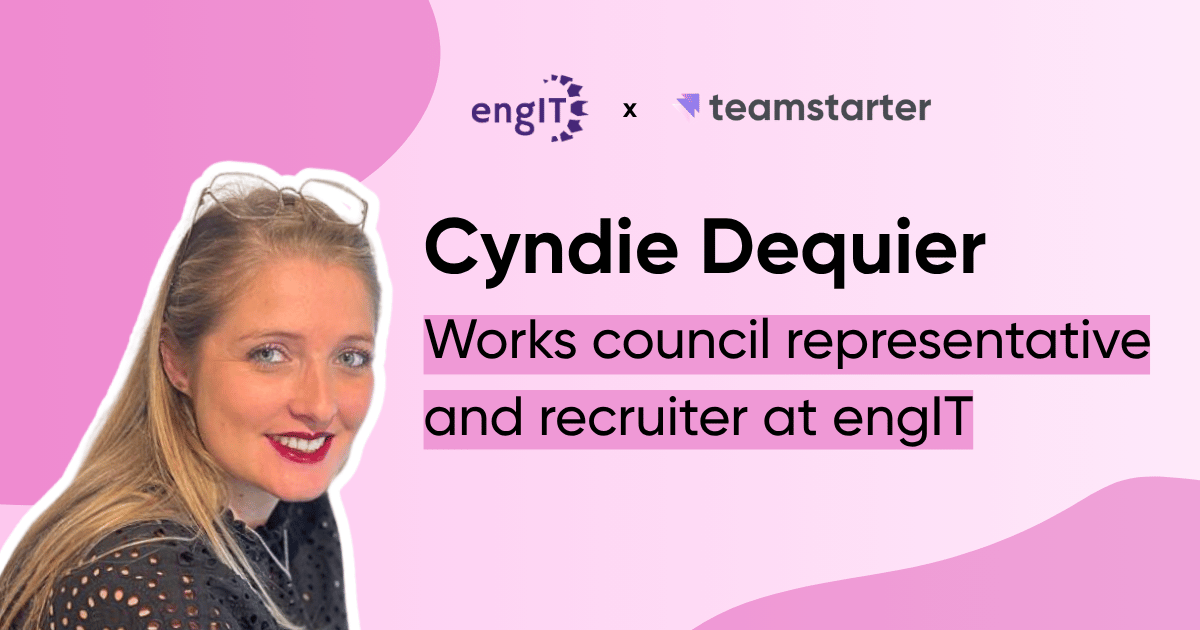
At engIT, team cohesion and workplace wellbeing are essential HR priorities. But when teams grow, spread across multiple sites, and works council representatives wear several hats at once, how do you keep building connection without it becoming a source of mental load?
Context
engIT is an IT services company specialized in digital transformation. Since its creation, it has grown at a sustained pace to reach more than 150 employees today, spread across 7 sites in France and Monaco.
"When we were all in Sophia Antipolis, everything was simple. But the moment we started opening other offices, we saw that spontaneous engagement was no longer enough. We had to create real momentum."
Arnaud Geoffroy, co-founder of engIT
At the heart of the works council: Cindy Dequier, both an elected representative and a recruiter. A dual role, dual responsibility, and a reality many representatives know well.
"People don't realize. We prepare meetings, support colleagues, manage events, quotes, budgets… all alongside our actual job."
Cindy Dequier, works council representative and recruiter at engIT
Challenges
Running a works council in a fast-growing, multi-site company means constantly juggling engagement, logistics, and legal constraints. For Cindy and the engIT team, five challenges quickly stood out:
- Fédérer des équipes éclatées géographiquement : Les collaborateurs sont répartis sur 7 sites : difficile d'organiser des événements qui rassemblent vraiment.
- Faire face au "no-show" : « On lançait des événements… mais sans toujours savoir s'ils plairaient. Résultat : parfois les gens ne venaient pas. »
- Ne pas porter la charge mentale seule : Cindy est investie, mais le temps lui manque. L'organisation d'un événement peut vite devenir un sprint logistique.
- Répondre aux vraies attentes terrain : Difficile de savoir ce que veulent réellement les collaborateurs sans outil de feedback structuré.
- Clarifier l'usage des budgets CSE : Les salariés s'attendent à ce que "le CSE paie tout". Or, la législation impose une distinction entre budget fonctionnement et budget œuvres sociales, qui est parfois mal comprise.
The solutions put in place with Teamstarter
Faced with these challenges, engIT chose to deploy Teamstarter. Within a few months, the platform became a real lever for structure, engagement, and breathing room for the works council.
1. Involving employees in designing the projects
The principle is simple: any employee can propose a project idea, put it to a vote among colleagues, then lead it with a budget pre-approved by the company. This reversal of logic changed everything. It's no longer the representatives guessing what might appeal — it's the employees themselves who surface the initiatives.
"That's what I love about Teamstarter: these aren't our works council ideas, they're their ideas. And that changes everything."
Employees feel like participants, not just guests. Engagement is natural and genuine.
2. Prioritizing through votes and platform data
Every proposed project is visible on the platform, and employees vote. This system makes it possible to prioritize without debate: the most popular projects naturally rise to the top. Participation data offers an objective reading that representatives can own and present to management. No more organizing on gut feeling.
3. Tracking budgets and respecting the legal framework
On the budget question, Teamstarter also brought clarity. The platform structures spending in line with the right budgets and makes it easier to communicate to employees about what can and cannot be funded.
"We were also able to explain that not everything could be funded by the works council. Teamstarter helps make all of that more transparent."
4. Reducing the mental load on representatives
Finally — and this may be the most concrete benefit for Cindy — the mental load has decreased. With Teamstarter (and her partner Mélissa, head of internal communication), she can delegate, plan, and manage her role as a representative without sacrificing her job.
"On my own, I couldn't manage it. But here, with the help of the tool and a good partner, it's become smooth."
The results
- 66.7% participation rate: 122 of 183 registered employees have already taken part in at least one project.
- A diversity of activities: hiking in the Calanques, a League of Legends night, karting, themed office parties.
- Continuous engagement, even remotely, no longer tied to a fixed works council calendar but to a constant flow of ideas driven by the teams.
- A stronger link between the works council, HR, and management: at engIT, the works council isn't a counterweight — it's a driver of cohesion.
Conclusion
engIT didn't change its works council's mission, but its way of working. By shifting from a top-down organization to a collective, structured, and well-equipped approach, the company lightened the load on its representatives, boosted employee engagement, and brought real new energy to its internal life. Proof that a well-equipped works council is also a works council that's better heard.