Context
A leader in digital transformation, Sopra Steria has 51,000 employees worldwide. Its Aeroline division, dedicated to the aeronautics and space sector, brings together 5,800 experts across 8 countries (France, Europe, India, Canada). It supports major players such as Airbus, Safran, Dassault, and Thales in a constantly evolving technological environment: AI, cybersecurity, cloud.
Challenges
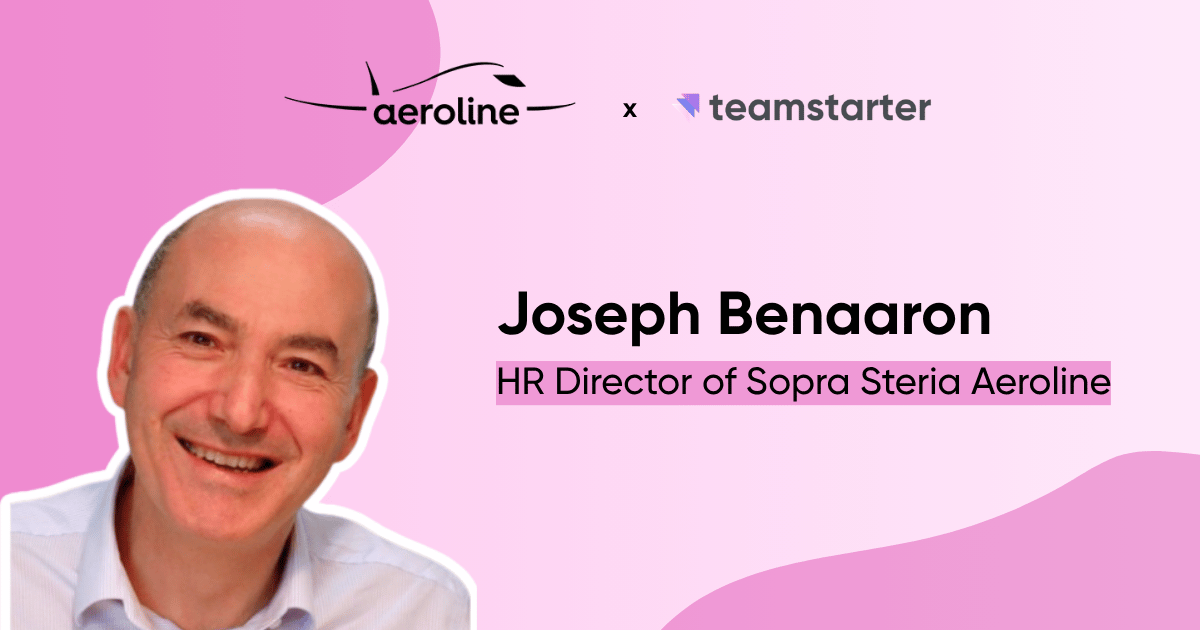
For Joseph Benaaron, HR Director of Sopra Steria Aeroline, culture is the compass that makes it possible to take complex decisions in a fast-changing world. Several challenges were identified:
- Anchoring historic values (created in 1968) in today's operational reality.
- Moving from a top-down culture (driven by the executive office) to a culture owned by the field.
- Breaking down geographic and organizational silos in a multi-site, international organization.
- Turning engagement into performance, following the equation: Engagement = Retention × Performance.
"Culture and values are what guide us through difficult moments. When we need to take a complex decision, we often anchor ourselves to our values to adapt to a world that's changing very fast."
Joseph Benaaron, HR Director, Sopra Steria Aeroline
The solution
For a culture to live, it has to be co-built with employees, not simply communicated from the top. In 2022, Sopra Steria Aeroline chose Teamstarter to make it one of the operational drivers of this ambition: employees propose, vote on, and fund projects themselves, using budgets provided by the company. A logic of participatory delegation that gave rise to initiatives such as the Aeroline Academy and cross-office technology workshops — projects born from the field, for the field.
Concretely, the platform makes it possible to:
- Bring culture to life through action: rather than staying in the realm of stated values, Teamstarter turns them into concrete projects led by employees themselves. It's culture built one action at a time.
- Measure engagement continuously: the platform captures employees' votes, comments, and shares in real time, giving leadership a live, instant reading of the collective mindset.
- Bring teams closer: in an organization spread across 8 countries, Teamstarter projects transcend geographic borders between countries and offices, creating connections where silos might otherwise have set in.
The results
- Massive adoption of the approach: more than 3 in 4 employees (76.4%) have embraced it — a rate that reflects natural, rather than imposed, buy-in.
- Geographic de-siloing: collaboration crosses borders, with 56.4% of projects being "cross-site," proving that barriers between countries and offices are fading.
- Operational momentum: a genuine "initiative factory," with an average of 22 projects approved every month — nearly one new concrete project launched per working day. The platform also records around 2,000 monthly actions (votes, comments, shares), becoming the true "pulse" of the organization.
- Retention and performance: engagement is now steered through cross-referenced indicators, including the completion rate of development plans and the retention rate, particularly for strategic profiles.
Conclusion
Sopra Steria Aeroline's success shows that company culture isn't a marketing concept, but a performance lever managed with an engineer's rigor. By reconciling a strategic vision driven by the executive office with complete freedom of action left to the field, the organization created a framework where individual initiative serves collective ambition.
Using Teamstarter turns this culture into concrete actions, making every employee an agent of their own day-to-day and career. By placing motivational management at the heart of its model, Joseph Benaaron proves that motivation is the most powerful driver of long-term retention and growth.